In conventional metallic conductors, electrical resistance causes energy losses. This effect becomes particularly significant at high currents and poses a major challenge for applications such as power transmission, high-field electromagnets, and high-power motors and generators. Such technologies are essential for fusion reactors, wind turbines, magnetic resonance imaging (MRI) systems, magnetic-levitation trains, and electric propulsion systems.
Superconducting materials can carry electric current without Ohmic losses when operated below their critical temperature and within their critical current and magnetic-field limits. Under these conditions, conduction electrons form Cooper pairs that move through the material without electrical resistance. High-temperature superconductors (HTS) are complex oxide ceramics whose critical temperatures exceed the boiling point of liquid nitrogen. Over the past three decades, they have advanced to the point where large-scale industrial applications are becoming feasible.
Read more
Modern second-generation (2G) HTS tape production typically begins with an Inconel substrate strip just 50–100 µm thick. A multilayer template is deposited onto the strip to create the required crystallographic alignment, followed by a superconducting rare-earth barium copper oxide (REBCO) layer. Commonly used vacuum deposition technologies include ion-beam-assisted deposition (IBAD) and sputtering for the template layers, as well as pulsed laser deposition (PLD), metal-organic chemical vapor deposition (MOCVD), and electron-beam physical vapor deposition (EB-PVD) for the REBCO layer.
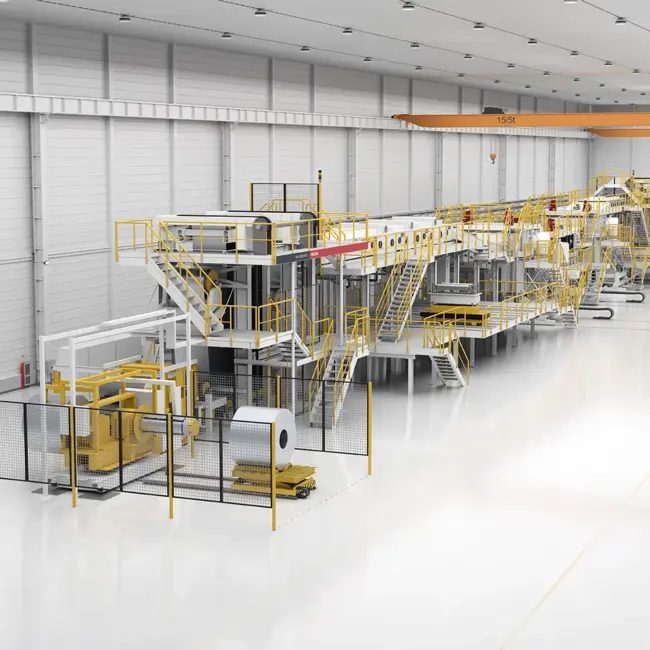
As a leading supplier of large-scale industrial metal-strip coating systems, VON ARDENNE combines extensive PVD process expertise, proven vacuum equipment capabilities, and a strong track record in scaling advanced deposition technologies. This makes us an ideal partner for HTS tape manufacturers transitioning from pilot production to industrial-scale manufacturing—a capability already demonstrated in multiple scale-up projects within the HTS industry.